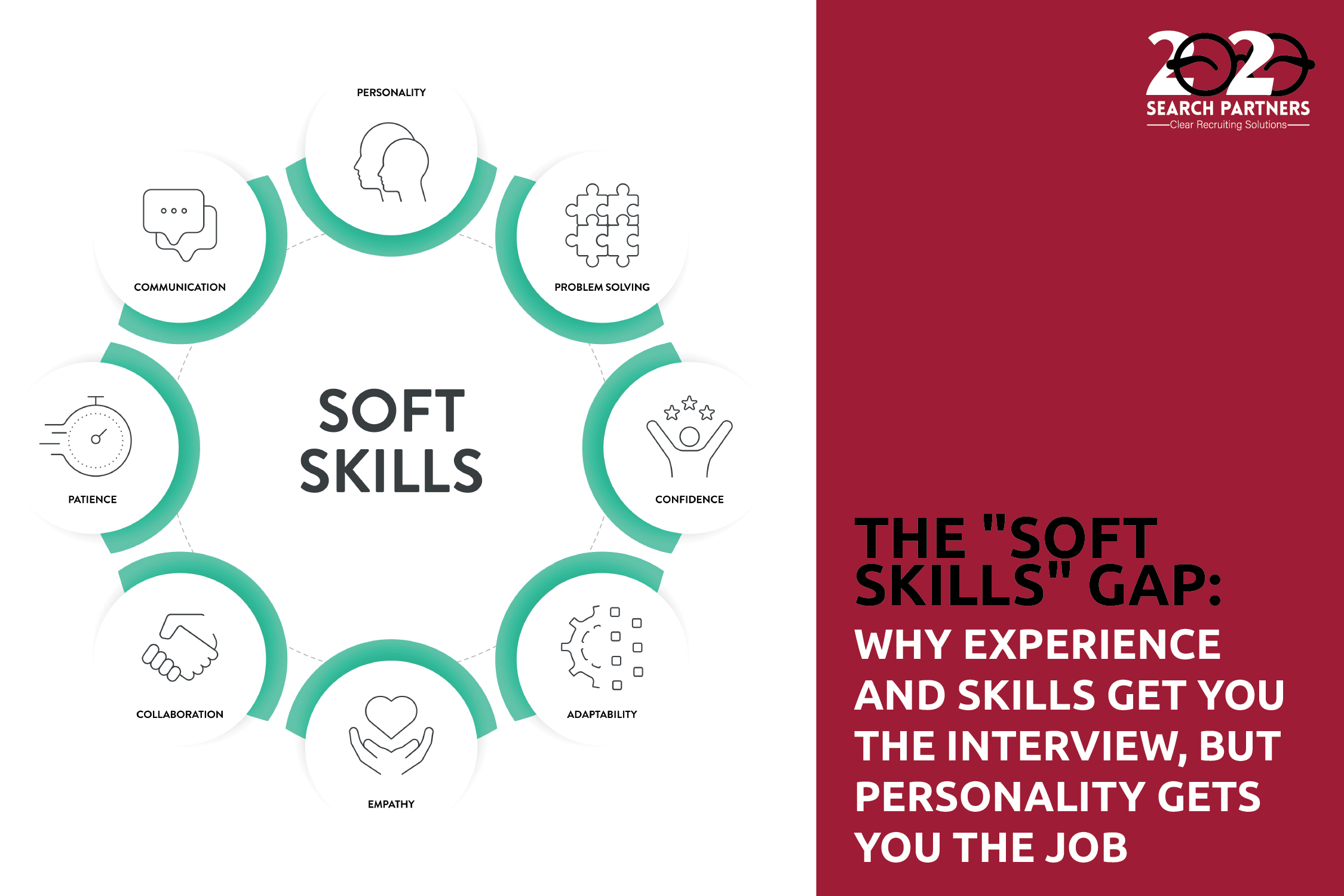
The “Soft Skills” Gap: Why Experience and Skills Get You the Interview, But Personality Gets You the Job
In the industries we serve—Commercial MEP (Mechanical, Electrical, Plumbing) service companies, value-engineering, and customized manufacturing—your resume is your ticket to the game. If you don’t have the track record, the management history, or the sales figures, you likely won’t make it past the initial screen.
But here is the hard truth that many qualified candidates miss: Experience and skills rarely win the tie-breaker.
As we settle into 2026, employers are placing a premium on “soft skills”—communication, emotional intelligence, and strategic thinking. Why? Because specific skills and processes can be taught, but attitude and aptitude are inherent.
Here is what top employers are looking for in the interview room (and how you can demonstrate it).
1. Passing the “Airport Test”
In relationship-driven roles like Sales, Project Management/Managers, or Service Management, hiring managers often ask themselves a simple, unspoken question: “If I were stuck in an airport with this person for four hours during a delay, would I be miserable?”
This isn’t about being the funniest person in the room. It’s about likability and composure.
- The Tip: Don’t be a robot. It is okay to smile, make small talk, and show your personality. Employers are hiring a human being, not just a set of stats. They want to know that you can interact with their clients and teams with the same level of respect and ease you show them.
2. Storytelling vs. Listing
A common mistake we see with experienced candidates (especially tenured managers and executives) is assuming that titles impress more than results. They assume the context of their resume is obvious and focus heavily on high-level strategy without explaining the execution.
Employers don’t just want to know what you achieved; they want to know how you achieved it.
- The Tip: Use the STAR Method (Situation, Task, Action, Result) to give your wins context.
- Don’t say: “As General Service Manager, I grew PM revenue by 32% in the first 12 months.”
- Do say:
- Situation: “When I joined the company, PM agreements were treated as add-ons rather than a core revenue stream. Renewal rates were under 70%, and technicians weren’t aligned with the sales team.”
- Task: “I was asked to stabilize renewals and grow PM revenue without adding headcount.”
- Action: “I worked with service managers to identify the top 20% of accounts by margin and risk exposure. I built a standardized PM proposal tied to asset age, failure history, and energy impact. I also trained technicians to flag repair-to-PM conversion opportunities using a simple checklist in the field.”
- Result: “Within 12 months, PM revenue increased 32%, renewal rates climbed to 88%, and emergency calls dropped enough to free up two techs’ worth of capacity during peak season.”
3. Strategic Questions are a Form of Respect
Nothing sours an interview faster than the candidate not having any questions prepared for the interviewer.
Even if you feel the interviewer covered the basics, saying “I think you answered everything” signals disengagement. It suggests a lack of curiosity. The message you are inadvertently sending is: “I don’t care, or I assume I already know everything.”
- The Tip: Do your research on the company and the interviewer beforehand. Have a list of 4–6 strategic questions prepared.
- What to ask: Reference recent company developments, ask about the interviewer’s background and their impression of the competition, or ask about the specific problem this role solves for the company. This turns the interview from an interrogation into a consultation.
The Takeaway
Your experience and skills prove you can do the work. Your soft skills prove you are the person they want to work with.
At 2020 Search Partners, we help candidates highlight their full value—both hard and soft skills—to the best employers in the market.
Ready to make your next move? Don’t navigate the market alone. Submit Your Resume today and let’s find a role that fits your goals.